
When you think about Norwegian artists and famous Norwegian paintings, I think you will immediately think of Edvard Munch and his well-known painting entitled Scream. However, there were many great Norwegian artists and some of them have featured in my blogs such as the Romantic artist Thomas Fearnley, Peder Balke, Eilert Adelsteen Normann and Harriet Backer to mention just a few. Today I am looking at the life and works of another great Norwegian artist, Nikolai Johannes Astrup.
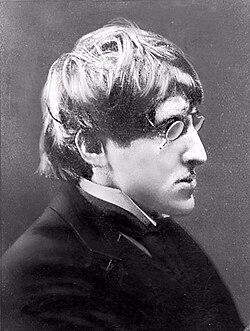
Nikolai Johannes Astrup (c.1910)
Nikolai was born on August 30th, 1880, in the village of Kalvag Bremanger, a municipality on the coast in Vestland county on the west coast of Norway but spent his early years in the nearby village of Ålhus. He was the eldest of fourteen children. His father, Christian Astrup, who came from a family of civil servants, became a parish priest at the Lutheran Ålhus Church in Jølster; his mother, Petra Konstanse Lodtz, was the daughter of Peder Mørch Lodtz, a glove manufacturer from Bergen. When Nikolai was three years old, the family moved to the municipality of Jølster following his father receiving the priesthood at the local church. The vicarage was both a residence and an ordinary working farm and Nikolai learned practical farm work as a boy. The vicarage was relatively poor and the farmhouse was partly rotten and run down.
Nikolai had a troubled childhood often rebelling against his father’s strict Christian morals. He also suffered from ill health and had to endure a life of isolation but gained pleasure from his love of drawing.
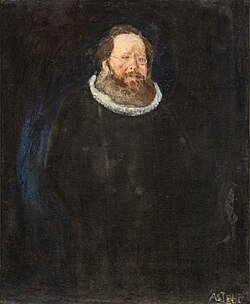
Nikolai’s father, Christian (1900)
His schooling started at home before, as a teenager, he went to live with his grandmother in Trondheim where from 1895 to 1897 he attended the cathedral school. However, due to his continuous bouts of illness (asthma) and his general dislike of school, his school achievements were limited to the one subject, natural sciences.
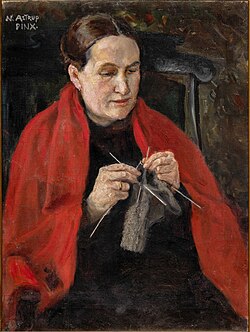
Nikolai’s mother, Petra (c.1900)
It was expected that as the eldest son he would become a priest like his father or maybe a magistrate. This was a custom in the Astrup family and so his father allowed Nikolai to move to the cathedral school, which would then lead him to become a priest but unknown to his mother and father Nikolai had discounted that idea from an earlier age.
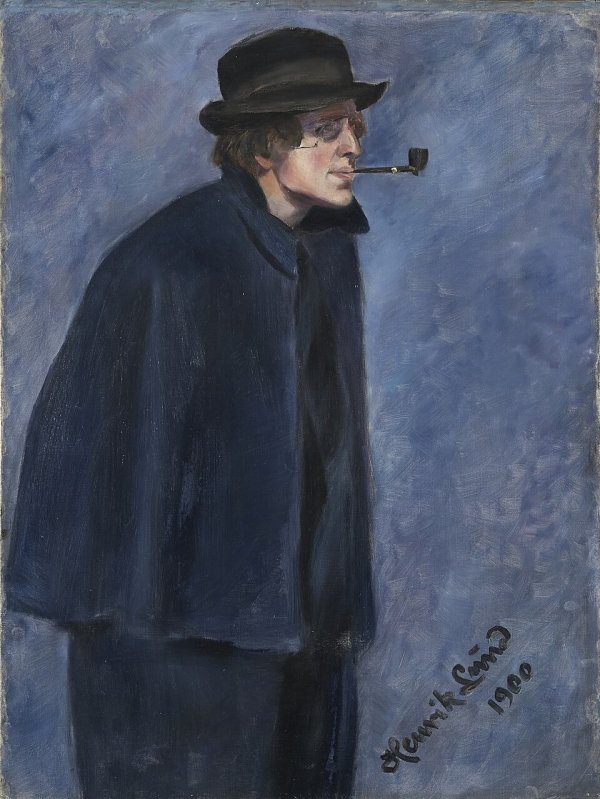
Nikolai Astrup painted by his friend Henrik Lund in 1900
Instead Nikolai had decided that he would become an artist. The year he attended the Cathedral School it was noted that due to ill health Nikolai missed a lot of the school year and his grades were the worst in the class, and among the worst that year. Astrup biographer Øystein Loge suggests that some of his abences were due to him missing classes to visit Trondhjems Kunstforening (TKF) which is described as:
“… a meeting place in Trondheim where art enthusiasts of all ages, professional artists and amateurs have a common arena to experience and create visual art, as well as share their art experiences…”
It was here that he could see the works of the great Norwegian artists. Prior to moving to Trondheim, he had little contact with the paintings of well-known artists but once living in the city he was able to visit museums and take in the works of famous painters. The inevitable clash with his parents came after he completed his schooling but refused to join the priesthood saying his future lay in the world of art. Living back with his family the war of words lasted for a couple of years during which time he was tasked with the tutorship of his young siblings. He also designed wall hangings to be woven by his mother.
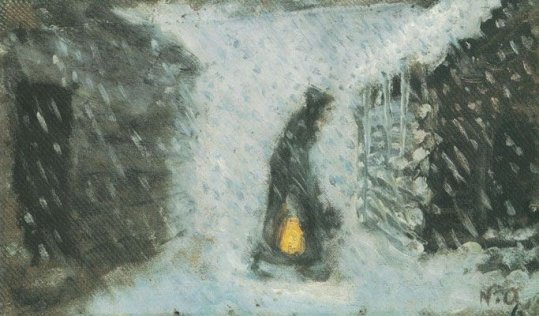
Kjerringa med Lykta (Old Woman with a Lantern) by Nikolai Astrup (1895-99) One of his early paintings, Kjerringa med Lykta (Old Woman with a Lantern) was one of three Astrup created as a teenager who had little money and could not afford to buy canvases and instead used fabric from old trousers.
The painting depicts an elderly woman, dressed in black, hunched over, carrying a lantern which glows in the darkness. She is seen walking between two dark brown log cabins. It is a winter scene during heavy snowfall and we can feel the cold as we see long icicles hanging from the roof of the cabin on the right. The passage between the two cabins is filled with snow, and still more heavy snow falls on the cabins and on the woman. In his notebook Nikolai described the scene:
“…Early winter morning (fantasy) Snowdrifts. Grey on grey, white and blue, light grey sky with dark grey flakes. The only element not fitting into this grey scheme is a lantern carried by a dark grey figure. The pinkish light cast against the snow fuses with the lantern’s form. A vague suggestion of daylight [is] the only [thing] showing itself over the rounded snow shapes on a rooftop […] The grey probably contains some colors, but these are so subtle, they are not noticed, and nowhere is one stronger than another, to the extent that it sticks out!…”
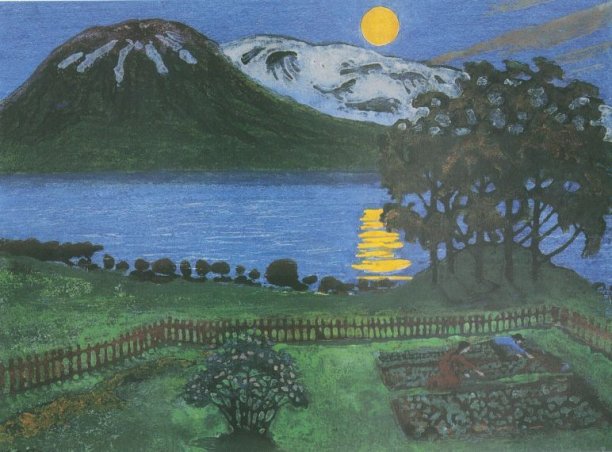
“May Moon” (woodcut with hand-colouring. An example of Nikolai Astrup repeating several times a motif (Kollen) he painted for the first time as a child.
Finally, in 1899, aged 19, Nikolai was allowed to leave home and go to Kristiania (Oslo since 1924) where he spent just two weeks attending evening classes in printmaking at the Royal School of Drawing (Kongelige tegneskole), before he enrolled at Harriet Backer’s private painting school. Here he studied life drawing, worked in oil, and produced his first etchings. It was also here that he started to develop what was to become his Neo-Romantic style. Nikolai did not receive any financial support from his family and struggled to survive and pay the course fees and yet his achievements at the drawing school were exceptional and Backer was suitably impressed with his progress and later described him as one of her most promising students:
“…I allowed him to work in the direction he wanted, as I understood he was the true genius of the school…”
He remained at the painting school until the autumn of 1901 when the Norwegian painter Kitty Kielland, a colleague of Harriet Backer, recommended Nikolai for the Olaf Schou’s travel scholarship which allowed him to travel through Germany to Paris, where he enrolled to study at the Académie Colarossi under the Norwegian painter Christian Kohg. Although attending the academy for just one year he made an impression on his tutor. Kohg commented:
“…When I speak of Mr. Nicolai Astrup as an artist, it cannot be the way an older artist speaks of a young artist as a ‘beginner’. Mr. Astrup is in no way a beginner even though he has been painting for a very short time. His unique talent has brought him past the first phase of development, a period where most people stay for at least ten years…”
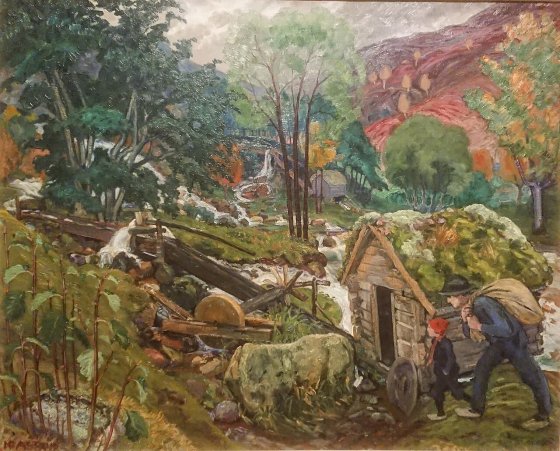
Kvennagongsvatten by Nikolai Astrup (1916)
In Paris Nikolai took the opportunity to visit art museums and one of the artists who impressed him was the Japanese ukiyo-e woodcuts artist Utagawa Hiroshige and he believed that his style could work when depicting the austere yet vivid landscape of his Norwegian homeland. Now based in Paris he was able to journey to other European countries. He became a lover of works by the French primitive painter, Henri Rousseau and the Swiss Symbolist painter Arnold Böcklin. Of the latter he is recorded as saying:
“…It seems to me at the moment that there is no artist I understand as well as him, but maybe [he] is also easy for everyone to understand […] what is most exciting about his pictures is their unexpectedness, a moment that sends a shiver down one’s spine, and yet one can enjoy the sight of them for a long time afterward…”
So enamoured by the Swiss painter, he named his first son who was born in 1914, Arnold Böklin Astrup !
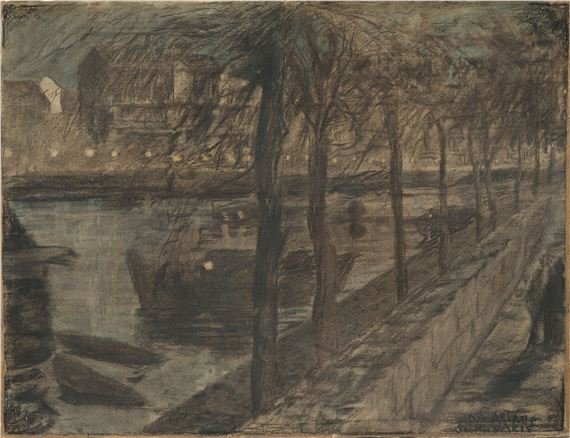
From the Seine by Nikolai Astrup (1901)
Very few of Astrup’s Paris paintings, exist with the exception of his 1901 charcoal and watercolor on paperwork work entitled From the Seine. Whilst staying in Paris, Astrup took the opportunity to make short trips to Berlin, Dresden and Hamburg with the aim of visiting museums and studying their treasures.
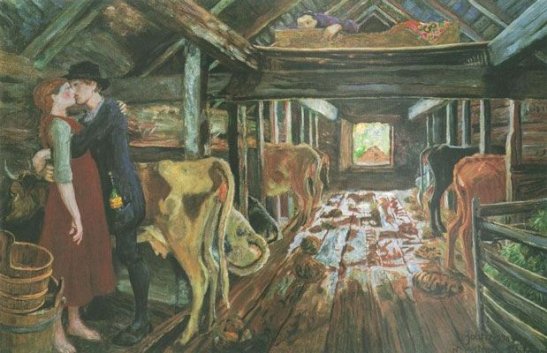
Fjøsfrieri, (Courting in the Barn) by Nikolai Astrup (1904)
One of his paintings, Fjøsfrieri Courting in the Cowshed, was completed a couple of years after he returned home from Paris. It depicts a view along the corridor of a wooden barn which is home to a herd of cows. In the left foreground we see a young couple in a romantic embrace. The young man is dressed in all black and we see a bottle of liquor poking out his jacket pocket. Both his arms are wrapped possessively around the young girl who we see standing barefoot and wearing a green shirt, red dress, and a headscarf. She is blushing and has one arm draped around the shoulder of the young man which adds to the amorous scene. In the upper centre of the painting, we notice a man laying in the hayloft spying on the young couple. A look through a window at the back of the barn, we see a hill and, beyond that, a glimpse of vibrant green foliage of a Spring landscape along with clear blue skies. The theme of love between two young people from a farming community was a foreshadow of Nikolai’s own fate and his love of his own farm girl, Engel, two years later.
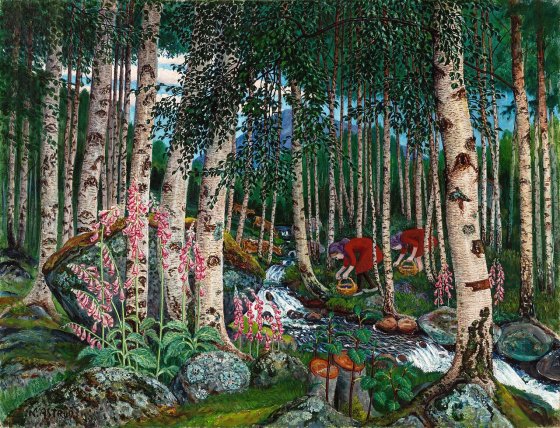
It took Astrup three months before he was satisfied with the printing of “Fox Bells”. It was printed in at least five variants. Astrup cut down a couple of trees for the sake of the composition, the stumps are visible in the foreground.
Astrup only stayed in France for a short period returning to Norway in the Spring of 1902 and although we cannot see many of his Parisian work, his tutor at Académie Colarossi, Christian Krohg, was full of praise with what Nikolai had produced, saying:
“…His extraordinary talent has meant that he has, as if in a game, undergone the first development, which generally stops others for at least 10 years. (…) I believe that he will be the one who will best assert the position of Norwegian art both at home and abroad…”.
…………………to be continued.
Information for this blog was gleaned from various websites such as Wikipedia and:













 my daily art display